


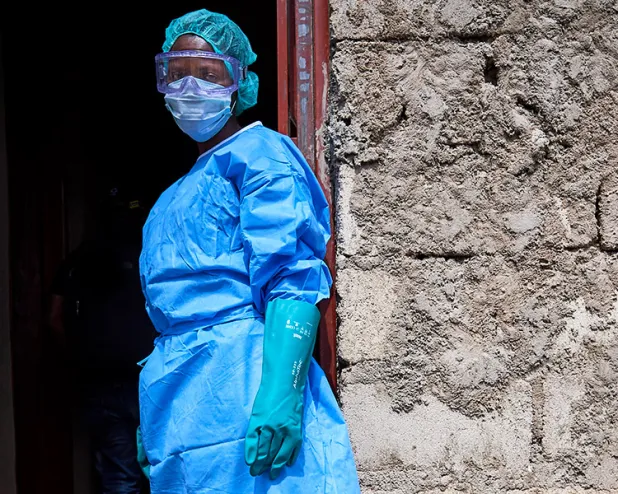
Q&A with experts from Corus International and IMA World Health
Dr. Bill Clemmer, Senior Regional Technical Advisor, Public Health and Ebola Response
Tamara Demuria, Chief Humanitarian Officer
The Democratic Republic of the Congo is facing another Ebola outbreak, and global health organizations are racing to contain a deadly virus that is spreading rapidly through vulnerable communities. The outbreak involves the rare Bundibugyo strain of Ebola — a variant with no approved vaccine or proven treatment. As it moves through regions already strained by conflict, displacement and fragile health systems, there are fears of wider transmission without swift action.
Corus International and our global health organization IMA World Health have responded to five Ebola outbreaks, including the 2018-2020 outbreak, which ranks as the second-largest Ebola outbreak in recorded history, behind only the 2014–2016 West Africa epidemic. We have supported community-based prevention, outbreak preparedness, infection prevention and control, and frontline healthcare delivery alongside local partners and Ministries of Health.
In this Q&A, two of our experts share what makes this outbreak especially concerning, what must be done to contain it — and why community trust, local leadership and long-term presence remain essential to effective Ebola response.
What makes this Ebola outbreak particularly concerning?
Clemmer: This outbreak poses an especially dangerous threat because it involves a strain of Ebola with no approved vaccine and no proven treatment. In the absence of those tools, containment depends almost entirely on how quickly health workers can identify cases, isolate infections, and reach communities with lifesaving information before the virus spreads further.
The virus is emerging in a region already strained by conflict, insecurity and large-scale population movement, where fragile health systems are struggling to keep pace. Remote terrain, weak infrastructure and ongoing instability are slowing response efforts in areas where delays can have devastating consequences.
As suspected cases spread toward larger population centers and transportation hubs, the outbreak could become far more difficult to contain without urgent intervention.
What do we know about Ebola — how does it spread and what are the symptoms?
Clemmer: Unlike respiratory viruses such as COVID-19 or influenza, Ebola does not spread through the air or casual contact. It spreads through direct contact with the bodily fluids of an infected person, or through contaminated surfaces and materials. In practical terms, transmission is most likely in caregiving situations, within households or in health facilities where infection prevention and control measures are not fully in place.
Early symptoms can look like many common illnesses: fever, fatigue, muscle pain, headache and sore throat. As the disease progresses, some patients may develop more severe symptoms, including vomiting, diarrhea, rash and, in some cases, bleeding.
What makes Ebola especially severe is how quickly a mild, flu-like illness can escalate into a life-threatening condition, particularly when diagnosis and supportive care are delayed. People die from Ebola when the virus overwhelms the body’s ability to regulate fluids and maintain vital organ function. In severe cases, it causes intense inflammation and damage to blood vessels, leading to fluid loss, internal bleeding and a dangerous drop in blood pressure. This can progress to multi-organ failure. Without rapid supportive care, such as IV fluids and close monitoring, the disease can quickly become fatal.
Corus has responded to previous Ebola outbreaks in DRC. What lessons remain most relevant today?
Clemmer: One of the most important lessons is that community trust determines whether response efforts succeed.
A vaccine is ineffective if people refuse it. Treatment does not help if patients are afraid to seek care. Contact tracing breaks down if families distrust responders or fear stigma.
Outbreak response is not only a medical effort — it is also a community effort. People need clear, culturally informed information delivered through trusted local voices.
That is why we have consistently worked with faith-based organizations, community health workers, teachers and religious leaders who already have trusted relationships within communities.
Those networks become critically important during moments of crisis.
How is Corus responding?
Clemmer: Because we are already present in 28 Health Zones in the DRC, we are able to work within our existing systems and networks to activate containment and treatment operations in high-risk zones across the Goma, Karisimbi and Nyiragongo health zones.
We are providing or supporting:
- Infection prevention and control measures in health facilities and community-based service sites
- Triage and isolation capacity for suspected Ebola cases
- Personal protective equipment and other critical supplies to frontline healthcare workers
- Contact tracing efforts to help identify suspected cases quickly
- Public health messaging to reduce misinformation and encourage safe care-seeking behaviors
- Ongoing essential healthcare services
- Psychosocial and mental health support for healthcare workers, affected families and quarantined individuals
What makes Corus International’s approach distinctive in outbreaks like this?
Demuria: In outbreaks like this, the value of our approach is the combination of long-term systems strengthening and immediate response capability.
IMA World Health has worked in the DRC for more than 25 years. We are known for supporting health and humanitarian programming across multiple provinces, and for our well-established relationships with the Ministry of Health, faith-based networks and community organizations.
This means we bring the capacity to rapidly reinforce national efforts when the scale or complexity of an outbreak exceeds existing capacity. That is what is happening now. Despite national preparedness, the size, spread and characteristics of this outbreak are placing extraordinary strain on the system.
During previous Ebola outbreaks, IMA World Health supported the establishment of triage and isolation units, delivery of PPE, and training for health workers and religious and community leaders. These investments continue to underpin response efforts today.
Why are faith-based and community partnerships so important in Ebola response?
Demuria: In many communities, faith leaders and local organizations are among the most trusted sources of information and support.
They help communities understand how Ebola spreads, why prevention measures matter, and when to seek care. They also help address fear, misinformation and stigma, all of which can undermine outbreak response efforts if left unaddressed.
We work closely with local faith-based and health partners because those relationships strengthen both public health communication and long-term resilience.
Outbreaks move quickly. Trusted relationships cannot be built overnight.
What does this outbreak reveal about global health preparedness more broadly?
Demuria: This outbreak reinforces the importance of investing in preparedness before emergencies happen.
Many surveillance systems still depend heavily on paper-based reporting processes that slow detection and response timelines. Strengthening digital capabilities, improving data analysis and supporting frontline health infrastructure can significantly improve how quickly outbreaks are identified and contained.
But preparedness is not only about technology or emergency plans. It is also about trust, local leadership and strong community health systems that can respond quickly when threats emerge.
Those investments save lives long before the next outbreak begins.